Last updated: November 17, 2026 · By Victor Mayfield
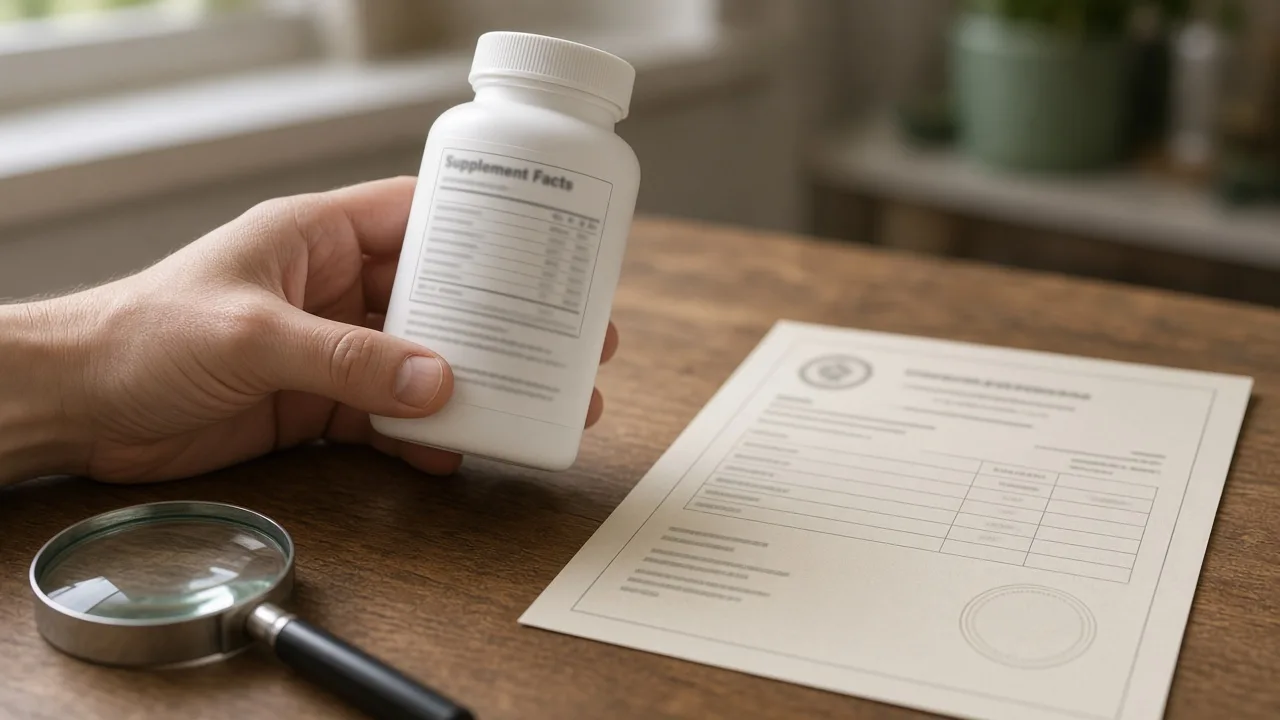
Walk down any vitamin aisle and you’ll see “third-party tested” on bottle after bottle, especially men’s products like tongkat ali, maca, horny goat weed and multivitamins. It sounds reassuring. But what does it actually mean, and how do you know whether the claim is real?
I spent my working life as a chemical engineer, around lab reports, batch records and quality audits. So I’ll say up front: “third-party tested” can mean a lot, or it can mean almost nothing. This guide explains the difference, shows you what the major seals (USP, NSF and Informed Choice) really check, and gives you a simple way to confirm a seal before you buy.
Important: This article is general information, not medical advice. A quality seal tells you about what is in the bottle. It does not tell you whether a supplement is safe for you or whether it will work. Talk to your doctor or pharmacist before starting any supplement, especially if you take prescription medicines or have heart, blood pressure, liver or kidney problems.
Why “third-party tested” matters for men’s supplements
Dietary supplements are not checked by the government before they go on sale. The U.S. Food and Drug Administration says it does not have the authority to approve dietary supplements for safety and effectiveness before they are marketed (FDA, Questions and Answers on Dietary Supplements). The company that sells the product is responsible for making sure it is safe and labeled correctly.
That gap matters more in the male enhancement category than almost anywhere else. The FDA keeps a running list of “sexual enhancement” products that were found to contain hidden prescription drug ingredients, such as sildenafil or tadalafil, that were never listed on the label (FDA, Tainted Sexual Enhancement Products). These hidden drugs can interact dangerously with nitrate heart medicines. I’ve covered several of these cases on this site, including our roundup of recalls and news for natural male enhancement products and the earlier recall on natural male enhancement products.
What “third-party tested” is supposed to mean
In plain English, “third-party” means someone other than the company that makes or sells the product. A real third-party program usually does some or all of these things:
- Identity: confirms the ingredients on the label are actually in the bottle.
- Strength (potency): checks that each ingredient is present in roughly the amount listed.
- Purity: screens for harmful levels of specified contaminants such as heavy metals, pesticides or microbes.
- Banned or hidden substances: some programs, especially sport programs, screen for drugs and substances that should not be there.
- Manufacturing: audits the factory against Good Manufacturing Practices (GMPs).
Here’s the catch: the phrase “third-party tested” by itself is not a regulated term. A brand can pay any lab to run one test, on one batch, for one thing, and then print “third-party tested” on every bottle for years. Even the word “standardized” has no legal definition for supplements in the U.S., according to the National Institutes of Health Office of Dietary Supplements (ODS). What counts is who did the testing, what they tested for, and whether you can check it.
The seals worth knowing
The ODS points shoppers to seals from independent organizations that offer quality testing. In its words, these seals indicate that a product “was properly manufactured, contains the ingredients listed on the label, and does not contain harmful levels of contaminants,” but they “do not guarantee that a product is safe or effective” (NIH ODS, Frequently Asked Questions). Here are the ones you are most likely to see.
USP Verified
The U.S. Pharmacopeia (USP) runs a voluntary Dietary Supplement Verification Program. According to USP, the USP Verified Mark means the product contains the ingredients listed on the label in the declared strength and amounts, does not contain harmful levels of specified contaminants, was made under FDA Good Manufacturing Practices, and will break down and release its ingredients within a set time. To earn and keep the mark, companies go through a facility audit, a review of manufacturing records, lab testing, and ongoing off-the-shelf testing (USP, Verified Mark).
NSF certification and NSF Certified for Sport
NSF is an independent testing and certification organization based in Ann Arbor, Michigan. Its Certified for Sport program is built to lower the risk of contaminated sport supplements. NSF says it is the only independent third-party certification program recognized by the U.S. Anti-Doping Agency, Major League Baseball, the National Hockey League and the Canadian Football League. Its site lets you search certified products by name, keyword or lot number (NSF Certified for Sport). You don’t need to be an athlete: a program built to catch banned substances is useful in a category where hidden drugs keep turning up.
Informed Choice and Informed Sport
These two programs are run by the testing company LGC. Both screen for more than 285 banned substances using ISO 17025-accredited methods. The difference is how often they test. Informed Sport tests every batch of a product before it is released. Informed Choice relies on regular blind testing of products bought from stores, with at least 12 random batches tested per year, so not every batch is guaranteed to have been tested (Informed Choice, Informed Sport vs Informed Choice). Both programs suggest checking your batch number on their websites.
You may also see a seal from ConsumerLab, an independent company that buys supplements from stores and publishes test results, much of it behind a paid subscription.
Red flags: when “tested” doesn’t mean much
Watch for these warning signs:
- A vague seal with no organization’s name. A gold circle that says “Lab Tested” or “Quality Assured” with no certifier named is decoration, not evidence.
- A seal you can’t look up. USP, NSF and Informed Choice all have public lookup tools. If the product isn’t listed, treat the claim as unproven.
- “Tested in an FDA-registered facility.” Registration means the facility told the FDA it exists. It is not an FDA approval of the product.
- A certificate of analysis (COA) from the brand’s own lab. That’s first-party testing. A COA is more useful when it comes from an independent, accredited lab and matches your lot number.
- Proprietary blends. If the label lists a “blend” with only a total weight, no lab seal can tell you how much of each herb you’re getting. I explain this in our breakdown of what’s in VigRX Plus.
- Big promises. Any product that claims to cure erectile dysfunction or work “like the blue pill” is making a drug claim that supplements are not allowed to make. Products like the ones in our Erectz review and Trivaxa Labs review are good examples of why that matters.
How to check a seal in five minutes
- Read the seal closely. Note the exact organization and program name.
- Go to the certifier’s own website, not a link on the seller’s page. Use the search tool there and type in the brand and product name.
- Match the details. Check that the product name, size and form (capsule, powder, gummy) match what you’re holding. For batch-tested programs, look up your lot number too.
- Compare the Supplement Facts panel. The ingredients and amounts should match what the certifier lists. Our guide to herbs for male enhancement explains the common herbs you’ll see on these labels.
- Check the FDA lists. Search the brand name on the FDA’s tainted sexual enhancement products page. A seal and an FDA warning should never appear together. If you see a warning, don’t take the product.
What a seal can’t tell you
A quality seal is about the product, not about you. Even a perfectly made, USP-verified herbal supplement can:
- interact with blood thinners, blood pressure medicines, diabetes medicines or antidepressants;
- be a poor choice if you have heart, liver or kidney disease, or a hormone-sensitive condition;
- simply not do what the marketing suggests, because a seal says nothing about effectiveness.
Problems with libido, erections or energy can also be early signs of conditions like heart disease, diabetes or low testosterone that deserve a real checkup. Please talk to your doctor before trying a supplement for these concerns. If you think a supplement made you sick, stop taking it, contact your doctor, and you can report it to the FDA through MedWatch.
Where to shop for certified products
If you want to start with products that carry a recognized seal, these Amazon searches are a convenient starting point: USP Verified men’s multivitamins on Amazon and NSF Certified for Sport supplements on Amazon. Results change and can include uncertified sellers, so confirm the specific product on the certifier’s website before you buy. Our older look at Amazon’s top-selling natural male enhancement products shows why that extra step matters.
As an Amazon Associate I earn from qualifying purchases. This doesn’t change the price you pay.
FAQ
Does “third-party tested” mean a supplement is FDA approved?
No. The FDA does not approve dietary supplements before they’re sold. Third-party testing is a voluntary, private program that the brand chooses and usually pays for.
Is a USP or NSF seal a guarantee that a supplement works?
No. The NIH Office of Dietary Supplements says these seals do not guarantee a product is safe or effective. They show that the product contains what the label says and doesn’t contain harmful levels of specified contaminants.
Are male enhancement pills ever third-party certified?
Some single-ingredient herbs and multivitamins carry recognized seals. Many products marketed for “sexual enhancement” do not. Always look the product up on the certifier’s own database rather than trusting a logo on a sales page.
What’s the difference between Informed Sport and Informed Choice?
Informed Sport tests every batch before release. Informed Choice tests products bought from stores on a regular schedule, with at least 12 batches per year, so not every batch is covered.
Should I talk to my doctor even if a product is certified?
Yes. A seal is about quality, not about your health history or your medicines. Your doctor or pharmacist can check for interactions and help you look for the real cause of symptoms.
Sources
- U.S. Food and Drug Administration. Questions and Answers on Dietary Supplements.
- U.S. Food and Drug Administration. Tainted Sexual Enhancement Products.
- NIH Office of Dietary Supplements. Frequently Asked Questions.
- U.S. Pharmacopeia. USP Verified Mark.
- NSF. Certified for Sport.
- LGC Informed Choice. Informed Sport vs Informed Choice.
- U.S. Food and Drug Administration. MedWatch Safety Information and Adverse Event Reporting Program.
Victor Mayfield is a retired chemical engineer who writes about natural male enhancement products. About this site.