The short answer on ashwagandha for men, stress and sleep: small, mostly 6- to 10-week trials in stressed or poorly sleeping adults found lower stress-scale scores, lower cortisol and modest sleep gains, largest in people with insomnia. Almost none of those trials studied men alone, few lasted past three months, and the one trial I found in men only did not beat placebo on fatigue. Rare liver injury, thyroid effects and drug interactions are the safety questions to settle first.
Last updated: November 27, 2026 · By Victor Mayfield
Note: This is general information, not medical advice. Talk to your doctor or pharmacist before trying ashwagandha, especially if you take medicine for blood sugar, blood pressure, thyroid, sleep, anxiety or seizures, or one that suppresses the immune system.
Why I read the studies before the label
As a retired chemical engineer, I want to know what was measured before I believe a result. Ashwagandha (Withania somnifera) is an Ayurvedic root sold as an “adaptogen” for stress and sleep; its species name comes from the Latin for sleep-inducing (NIH ODS). Men’s formulas lean on it hard, so here is what the trials covered and missed. If you are new to the category, start with my overview of herbs sold for men’s wellness and how to vet them.
What the stress studies measured
In a 60-day trial, 64 adults with chronic stress took 300 mg of a root extract (KSM-66) twice a day or placebo. Scores on every stress questionnaire fell more with ashwagandha, and serum cortisol dropped more too (Chandrasekhar et al., 2012). An eight-week trial in 60 stressed men and women compared 250 mg/day, 600 mg/day and placebo; both doses lowered Perceived Stress Scale scores and cortisol, and sleep quality improved versus placebo (Salve et al., 2019).
Not every measure moved. With 240 mg/day of a root-and-leaf extract (Shoden) for 60 days, anxiety ratings and morning cortisol fell, but the stress-anxiety-depression questionnaire only came near significance (Lopresti et al., 2019). A 2022 meta-analysis of 12 trials (1,002 people) found lower stress and anxiety overall but rated the certainty of the evidence low (Akhgarjand et al., 2022).
What the sleep studies measured
The largest sleep trial gave 150 adults with unrefreshing sleep 120 mg/day of Shoden or placebo for six weeks. Self-rated sleep quality rose 72% versus 29% on placebo, and a wrist activity monitor showed better sleep efficiency, total sleep time and time to fall asleep (Deshpande et al., 2020). In 60 people with insomnia, 300 mg of KSM-66 twice daily for 10 weeks shortened time to fall asleep and improved sleep efficiency and quality (Langade et al., 2019). An eight-week trial of 80 adults found the gains were larger in those with insomnia than in healthy sleepers (Langade et al., 2021).
Pooling five trials with 400 participants, a 2021 meta-analysis found a small but significant effect on sleep, more pronounced in people with insomnia, at 600 mg/day or more and after eight weeks or longer (Cheah et al., 2021).
| Study | Who | Extract, daily dose, length | Measured | Main result vs placebo |
|---|---|---|---|---|
| Chandrasekhar 2012 | 64 stressed adults | KSM-66 root, 600 mg, 60 days | Stress scales, cortisol | Lower scores and cortisol |
| Salve 2019 | 60 stressed adults | KSM-66 root, 250 or 600 mg, 8 weeks | PSS, anxiety, cortisol, sleep | Lower PSS and cortisol; better sleep |
| Lopresti 2019 | 60 stressed adults | Shoden root-leaf, 240 mg, 60 days | Anxiety, DASS-21, cortisol | Anxiety and cortisol down; DASS-21 not significant |
| Deshpande 2020 | 150 poor sleepers | Shoden, 120 mg, 6 weeks | Sleep questionnaire, actigraphy | Better sleep quality and efficiency |
| Langade 2019 | 60 with insomnia | KSM-66, 600 mg, 10 weeks | Actigraphy, PSQI, anxiety | Faster sleep onset, better quality |
| Lopresti 2019 (men) | 57 overweight men, 40-70 | Shoden, 8 weeks (crossover) | Fatigue, vigor, hormones | No difference in fatigue, vigor or cortisol |
What the studies didn’t measure, especially for men
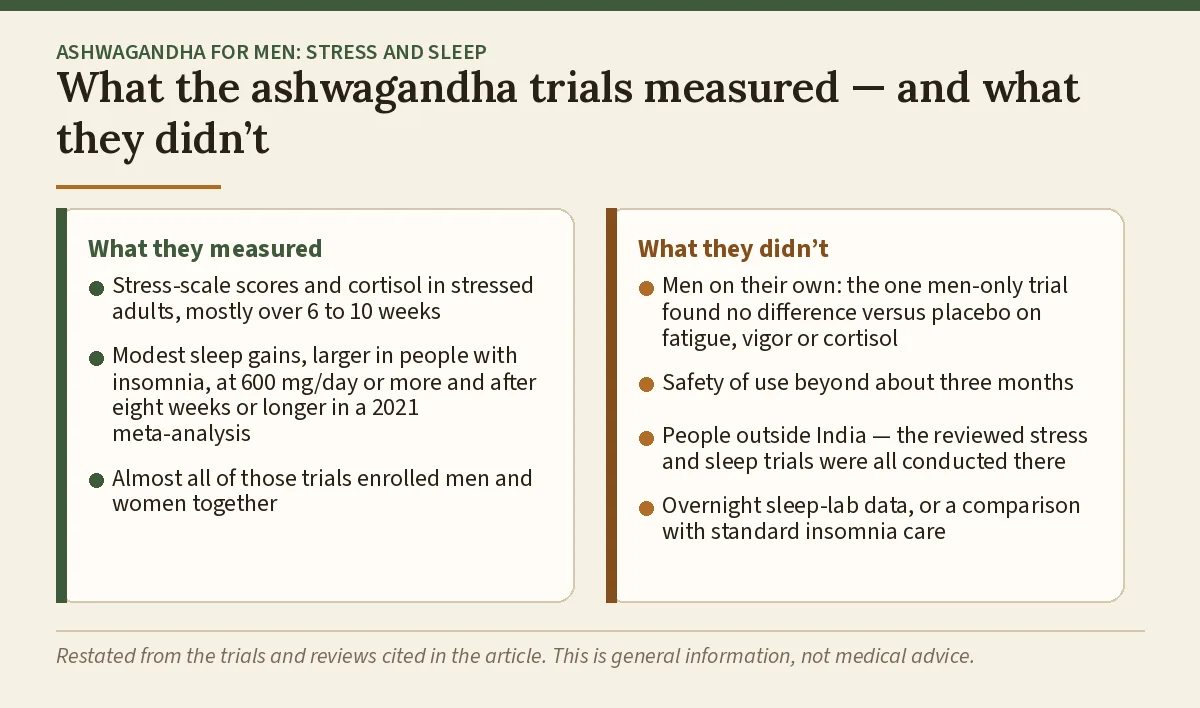
- Men on their own. The stress and sleep trials above enrolled men and women together. The one men-only trial I found, in 57 overweight men aged 40 to 70 with mild fatigue, saw no between-group differences in fatigue, vigor, cortisol or sexual well-being (Lopresti et al., 2019). Its hormone findings are outside this article’s scope and do not make ashwagandha a treatment.
- Long-term use. Ashwagandha appears well tolerated for up to about three months; safety over months or years is unknown (NIH ODS).
- Different populations. The seven stress trials in a 2021 review, and the five sleep trials in the 2021 meta-analysis, were all conducted in India (NIH ODS).
- Independent supply. In the Chandrasekhar, Salve and Langade 2019 trials, the KSM-66 extract was supplied by its manufacturer (2012, 2019, 2019).
- Interchangeable products. Trials used different extracts, plant parts and doses, so ODS says it is hard to name a specific extract or amount. One branded extract’s result does not transfer to generic root powder.
- Lab-grade sleep data. Sleep was measured with questionnaires and wrist monitors, not overnight sleep-lab studies, and no trial here compared ashwagandha with standard insomnia care.
Safety: who should skip it or ask first
Liver. Liver injury is rare but documented. A case series described five people who developed jaundice and itching after 2 to 12 weeks of ashwagandha-containing supplements; liver tests normalized within 1 to 5 months in four of them (Björnsson et al., 2020). An Indian series reported eight single-ingredient cases; three patients with existing chronic liver disease developed liver failure and died (Philips et al., 2023). Stop it and see a doctor for yellow skin or eyes, dark urine or persistent itching.
Thyroid. In 50 adults with subclinical hypothyroidism, 600 mg/day for eight weeks shifted TSH, T3 and T4 compared with placebo (Sharma et al., 2018), and case reports describe thyrotoxicosis that resolved after stopping (NIH ODS). NCCIH does not recommend it for people with thyroid or autoimmune disorders or before surgery.
Pregnancy. NCCIH says to avoid ashwagandha during pregnancy and not to use it while breastfeeding.
Interactions. NCCIH lists possible interactions with diabetes and blood pressure medicines, immunosuppressants, sedatives, anti-seizure drugs and thyroid hormone. It also advises people with hormone-sensitive prostate cancer to avoid it (NCCIH). Common side effects include drowsiness, stomach upset and diarrhea.
Restrictions abroad. Denmark’s food authority says it is illegal to sell products containing ashwagandha there (Fødevarestyrelsen), after a 2020 Technical University of Denmark assessment concluded that no intake limit for the root could be set below which there would be no risk of harm (DTU, 2020). France’s food safety agency advised against it for some groups in 2024, including pregnant women and people with endocrine disorders. For balance, the American Herbal Pharmacopoeia disputes the claim that the root causes miscarriage (NIH ODS).
Label checklist before you buy
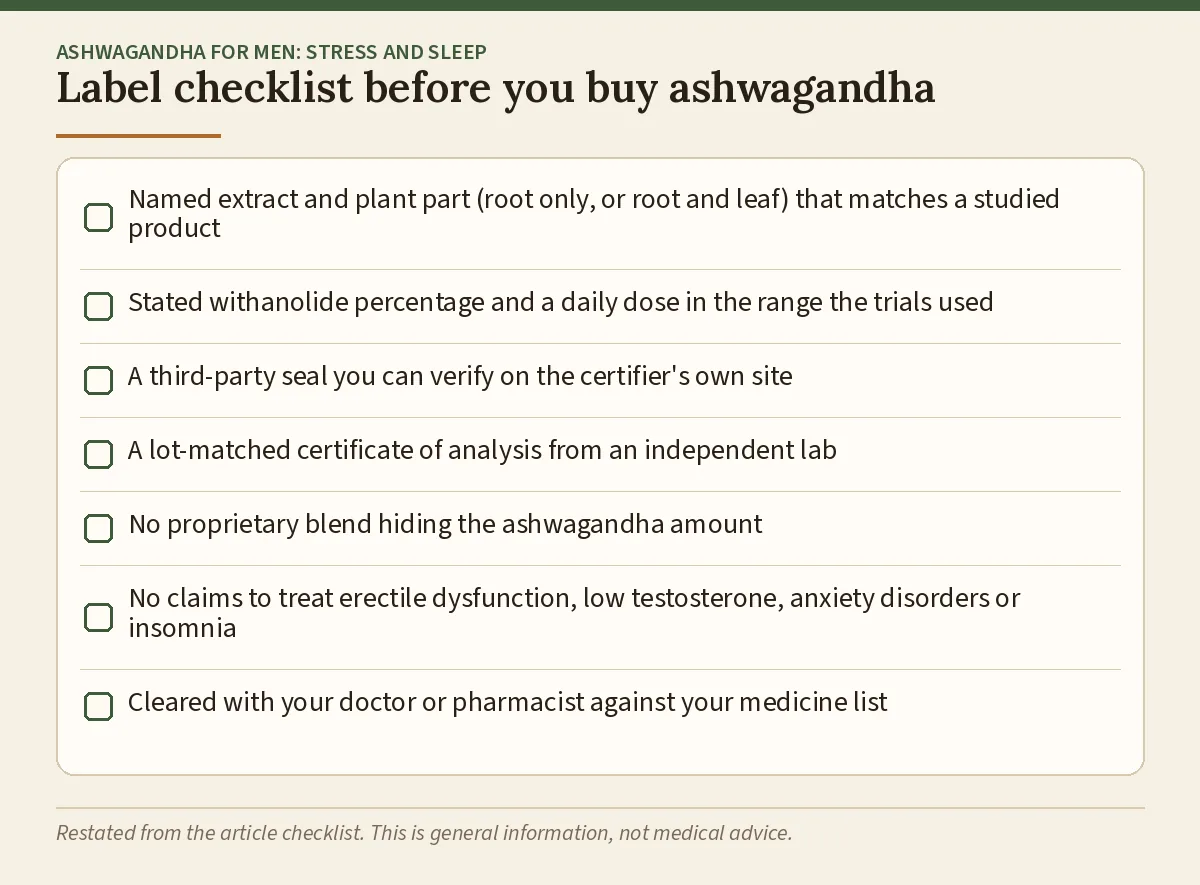
- ☐ Named extract and plant part (root only, or root and leaf) that matches a studied product
- ☐ Stated withanolide percentage and a daily dose in the range the trials used
- ☐ A third-party seal you can verify on the certifier’s own site (see what “third-party tested” really means on a supplement label)
- ☐ A lot-matched certificate of analysis from an independent lab; the same checks apply as in reading a tongkat ali COA
- ☐ No proprietary blend hiding the ashwagandha amount
- ☐ No claims to treat erectile dysfunction, low testosterone, anxiety disorders or insomnia
- ☐ Cleared with your doctor or pharmacist against your medicine list
Comparing herbs in men’s formulas? My review of tongkat ali vs maca vs fenugreek covers those studies. More single-herb guides are in our vitamins and herbs section.
Where to shop
Disclosure: Some links below are affiliate links. If you buy through them, we may earn a commission, at no extra cost to you. As an Amazon Associate, Natural Enhancement Products earns from qualifying purchases. This is not medical advice; talk with a licensed clinician before using any supplement. Read our full disclosure.
On Amazon, this search for ashwagandha KSM-66, third-party tested is a starting point, not an endorsement. Results include untested products, so check the seal and ask for a lot-matched COA first.
FAQ
Does ashwagandha help men sleep?
Trials in mixed groups of men and women found modest sleep improvements, larger in people with insomnia, at 600 mg/day or more for at least eight weeks. Persistent insomnia deserves a doctor’s evaluation.
How long does ashwagandha take to work for stress?
Most trials measured results after 6 to 10 weeks. Effects beyond about three months, and the safety of longer use, have not been well studied.
Is it safe to take ashwagandha every day?
It appears well tolerated for up to about three months in trials. Rare liver injury, thyroid changes and drug interactions have been reported, and long-term safety is unknown. Ask your doctor first, especially if you take prescription medicine.
Can I take ashwagandha with sleep or blood pressure medicine?
Ask your doctor or pharmacist first. NCCIH lists possible interactions with sedatives, blood pressure and diabetes medicines, immunosuppressants, anti-seizure drugs and thyroid hormone.
Why is ashwagandha banned in Denmark?
Denmark’s food authority treats it as illegal to sell after a 2020 risk assessment found no intake level that could be called free of risk, citing possible effects on sex hormones, reproduction, thyroid, the immune system and the nervous system.
Sources
- NIH Office of Dietary Supplements. Ashwagandha: Is it helpful for stress, anxiety, or sleep? (updated May 2, 2025).
- NCCIH. Ashwagandha: Usefulness and Safety.
- Chandrasekhar K, et al. Ashwagandha root extract in reducing stress and anxiety in adults. Indian J Psychol Med, 2012.
- Salve J, et al. Adaptogenic and anxiolytic effects of ashwagandha root extract in healthy adults. Cureus, 2019.
- Lopresti AL, et al. Stress-relieving and pharmacological actions of an ashwagandha extract. Medicine, 2019.
- Akhgarjand C, et al. Ashwagandha for anxiety and stress: meta-analysis. Phytother Res, 2022.
- Deshpande A, et al. Ashwagandha extract and sleep quality in healthy adults. Sleep Med, 2020.
- Langade D, et al. Ashwagandha root extract in insomnia and anxiety. Cureus, 2019.
- Langade D, et al. Ashwagandha root extract on sleep in healthy volunteers and insomnia patients. J Ethnopharmacol, 2021.
- Cheah KL, et al. Effect of ashwagandha extract on sleep: systematic review and meta-analysis. PLoS One, 2021.
- Lopresti AL, et al. Ashwagandha in aging, overweight males. Am J Mens Health, 2019.
- Björnsson HK, et al. Ashwagandha-induced liver injury: case series. Liver Int, 2020.
- Philips CA, et al. Ashwagandha-induced liver injury: case series from India. Hepatol Commun, 2023.
- Sharma AK, et al. Ashwagandha root extract in subclinical hypothyroid patients. J Altern Complement Med, 2018.
- Fødevarestyrelsen (Danish Veterinary and Food Administration). Ashwagandha i kosttilskud og drikkevarer (Danish).
- DTU National Food Institute. Risk assessment of Withania somnifera root (May 15, 2020, Danish).
Victor Mayfield is a retired chemical engineer from New York.